
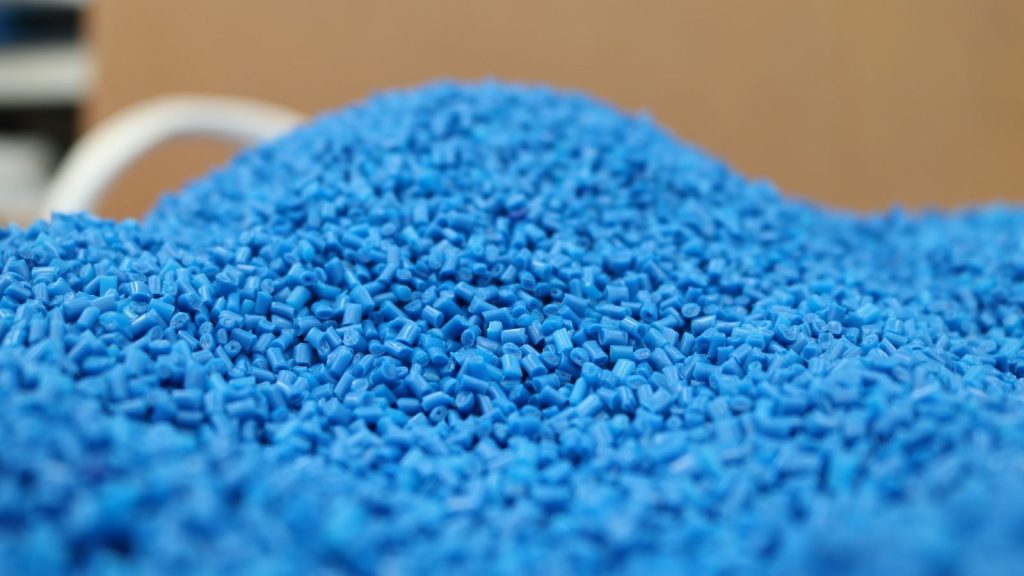
Masterbatch is a processing intermediate
Calcium-carbonate masterbatch is a mineral concentrate dispersed in a polymer carrier with an appropriate additive package. The objective is not the highest mineral fraction in a pellet, but consistent dispersion on converting equipment and an acceptable film or part at an economic let-down rate. Extruder design, carrier and final polymer make results from one application unsuitable for automatic generalization to all films, moulding or tapes.
Omya describes calcium carbonate in concentrates using different carrier resins [1] and positions Omyamax for loading and dispersion challenges in compounding and converting [2]. These illustrate application-driven mineral design. Supplier maximum loading or improvement percentages are not production guarantees without qualification on the customer’s line. Work backwards from the final article specification to the concentrate.
Size surface treatment and moisture interact
Particle size, distribution and agglomeration affect surface uniformity, defects and local stress. D50 alone is insufficient; thin-film applications need an understanding of the coarse tail and dispersion under actual shear. Surface treatment changes mineral interaction with carrier and auxiliaries. Surface-treated is an incomplete specification without treatment level, uniformity, stability and compatibility.
Moisture and volatiles can appear as vapour, voids or surface defects, with effects depending on polymer and processing temperature. Select methods that distinguish moisture from surface-treatment material that may be lost on heating; mass loss is not always water. Review powder and pellet storage, feeding and venting. Drying an unsuitable feedstock cannot repair solid contamination or an inappropriate particle distribution.
Carrier choice controls compatibility and dispersion
Select the carrier for the final polymer, conversion-temperature window and melt rheology rather than low price alone. A high-flow carrier may ease mineral incorporation yet change final processing or mechanical behaviour at substantial let-down. Relative viscosity between concentrate and base resin also affects pellet breakup and distribution; a similar polyolefin label does not establish equivalent dispersion.
Specify carrier type, mineral loading, lubrication package, volatiles and pellet density and uniformity. Compare feeding, torque stability, melt pressure and filter loading on representative equipment. Higher pressure may indicate agglomeration, contamination or compatibility problems rather than insufficient lubricant. Adding lubricant may in turn affect printing, bonding or die deposits, so downstream functions need testing.
Let down rate differs from final mineral loading
If a hypothetical concentrate contains 80% calcium carbonate and represents 15% of final blend mass, its mineral contribution is 12% and its remaining contribution is 3%. This is not the same as adding 15 kg concentrate to 100 kg resin. In that case, concentrate fraction is 15 divided by 115 and final mineral content is approximately 10.43%. Confusing the definitions changes performance and cost even when materials are unchanged.
To illustrate density, assume an ideal void-free blend of 88% polyethylene at 0.92 kg/L and 12% mineral at 2.70 kg/L, without additional contraction. Specific volume is about 1.001 L/kg, corresponding to approximately 0.999 kg/L. At equal thickness and area, film mass is about 8.6% above resin at 0.92 kg/L. Lower price per kilogram therefore need not give an equal reduction per square metre. These illustrative calculations do not predict cavitation in stretched film or permissible thickness changes.
The converted article determines acceptable loading
Compare a loading series using the same base resin and representative equipment while controlling actual thickness and conversion conditions. For film, evaluate tensile behaviour, elongation, tear or puncture, sealing and printing as function requires; for mouldings, assess dimensions, impact and surface. Increased stiffness is insufficient if a critical toughness requirement deteriorates. Separate mineral effects from changes in orientation or cooling.
Mineral can be used in deliberately porous films, as illustrated by Omya’s breathable-film applications [3], but CaCO3 does not mean every film should become porous. Define whether voids are intended structure or defects. Review contact and restricted-substance requirements for the article and market. One mineral certificate does not automatically cover carrier, auxiliaries and the finished article.
Diagnostics and economics meet at reject rate
Link results to mineral, carrier and concentrate lots and conversion conditions. If material price falls while rejects, filter loading or die-cleaning time rise, recalculate savings per accepted product. Retain a reference from the previous concentrate when changing grades; runs separated by multiple machine changes do not isolate the raw-material effect.
| Symptom | Hypothesis | Discriminating work |
|---|---|---|
| Holes or coarse specks | Agglomerates moisture or contamination | Microscopy volatiles and filtration |
| Rising melt pressure | Particle accumulation or poor dispersion | Pressure trend and filter-residue analysis |
| Poor sealing or printing | Surface change or additive migration | Aged surface and functional tests |
| Cheaper kilogram but no part saving | Density or reject increase | Accepted-part mass and conversion cost |
Technical references
- Omya — Polyolefin masterbatch
- Omya — Omyamax
- Omya — Omyafilm